
AI Overviews SEO in 2026: What Google Actually Says Works

What helps a page appear in Google AI Overviews or AI Mode in 2026? Google's current answer is less exotic than many “GEO hacks” suggest: publish original, useful content that answers a real question, make the page crawlable and usable, and ensure any structured data matches what people can see. Google says its AI features draw on its core Search ranking and quality systems; there is no separate markup or secret file required for inclusion. That does not guarantee a citation. It does give publishers a testable plan.
This article separates Google's documented guidance from reasonable editorial inference. It is for a site owner deciding what to improve on one page this month, not for someone selling a promise of top placement.
What Google actually changed in 2026
In May 2026, Google published a dedicated guide to optimizing for generative AI features. It explains that AI Overviews and AI Mode rely on Google's Search index and ranking systems, and that familiar SEO foundations still matter. Google's AI features documentation says there are no extra technical requirements or special optimizations for inclusion beyond the normal Search requirements.
That guidance matters because a growing market of “AI search optimization” products treats every new acronym as a new ranking system. Some tools may help with research or monitoring, but a claim that you must buy a special schema package or create an AI-specific text file to be eligible is not supported by Google's public documentation. Google's 2026 announcement specifically calls out common misconceptions about AEO and GEO.
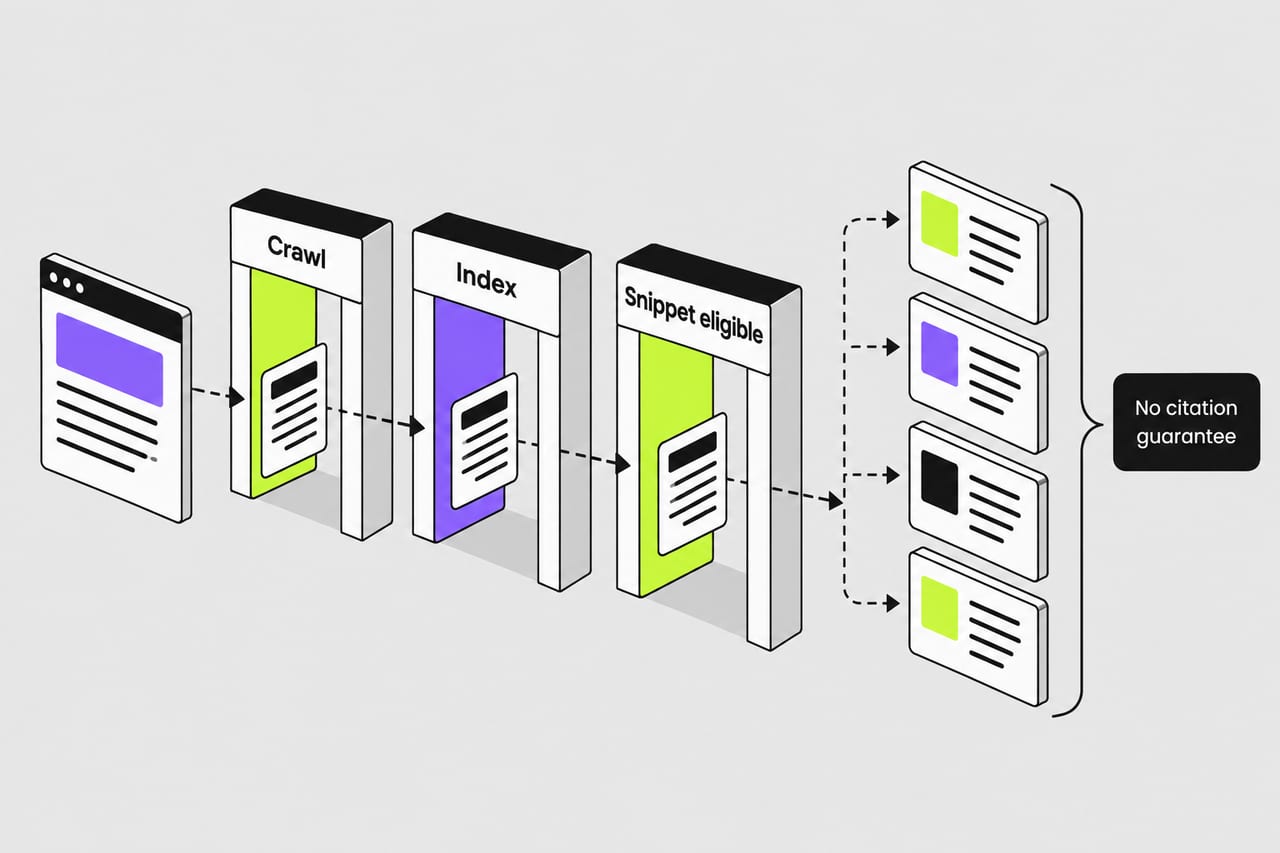
First make the page eligible to be found
An AI feature cannot reliably use a page Google cannot crawl and index. Start with the basics: the page should return HTTP 200, be accessible to Googlebot, avoid an accidental noindex directive, and contain its answer in indexable page content. Google lists these conditions in its guidance for AI experiences. Put the essential explanation in the rendered article, not only inside an image, a video, or a widget that fails to load.
Next inspect the page as a visitor. Does the title match the question answered? Is the answer easy to find without scrolling through ads and vague introductions? Does the mobile layout work? Google's advice ties useful content to a good page experience. Fast, readable pages are valuable even when no AI Overview appears for the query.
Write the answer a human actually came for
Consider a query such as “Why does clearing cache sometimes slow my phone?” A page that merely repeats “clear cache to speed up your phone” has missed the problem. A useful page explains what the cache stores, what happens immediately after deletion, when a corrupt cache is worth clearing, and what symptoms point to a different cause. It may include a short diagnostic table. That is original explanatory work, not keyword padding.
Google's people-first content guidance asks whether readers leave feeling they learned enough to achieve their goal, whether the content shows first-hand expertise or depth, and whether it adds value beyond other pages. The practical inference for AI search is straightforward: give both the reader and any summarizing system clear, verifiable facts that are worth citing. There is no guarantee that a clear answer will be selected, but a vague restatement has little reason to be.
Add what only your page can contribute: a reproducible test, an original diagram, an informed comparison, a worked example, or a clearly dated observation. For a changing topic, state when you checked it and link to the primary source. For a stable concept, explain the mechanism and trade-offs. Avoid publishing many near-identical pages for slight keyword variations; Google's guidance on AI-generated site content warns that scaled pages with little added value may violate spam policies.
Use structure to make meaning clear
A descriptive title, a direct introductory answer, logical headings, and well-labeled comparisons make a page easier to scan. They also reduce ambiguity about what each section claims. Use headings because they help the reader navigate, not because a template promises a featured snippet. Put dates beside time-sensitive information and make source links point to the precise supporting page where possible.
Structured data can help Google understand eligible content, but it must match the visible page. Google's AI-search guidance explicitly says to keep markup aligned with what visitors can see and to validate it against the relevant feature rules. Adding FAQ markup to a page with no visible questions is not a shortcut. The Google Search documentation changelog also records the May 2026 deprecation of FAQ rich results, a reminder that old SEO checklists age quickly.
Images and video can strengthen an explanation when they show a process or result that text alone cannot. Give them descriptive surrounding text and sensible alt text. A stock picture that merely fills space is less useful than one clear diagram showing what happens.
What to measure without pretending you can measure everything
Start with page-level outcomes you can observe: indexability, impressions, clicks, queries, engagement, and conversions. Use Search Console to see which questions bring the page into view. If a query cluster grows but clicks do not, review whether the title answers a different question from the page or whether the answer is fully resolved on the results page. Treat that as a hypothesis to test, not proof that an AI feature “stole” traffic.
You can also manually record whether your page is cited for a small, fixed set of important queries, the wording of those queries, the date, and the page cited. AI answers vary by user and over time, so an occasional screenshot is not a ranking metric. Separate brand mentions from source citations and record the page that was actually used. Do not turn a single observation into a promise that all users see the same result. For a deeper measurement framework, see our guide to AI search visibility ROI.
When you update a page, annotate the change: new evidence, clearer answer, faster load, or better internal navigation. Compare trends over enough time to reduce day-to-day noise. If you change the article, title, navigation, and template all at once, you will struggle to know what helped.
A practical one-page audit
- Question: Write the main question the page answers in one sentence. If that is hard, narrow the page.
- Answer: Confirm the first screen gives a useful answer, with nuance where needed.
- Evidence: Mark every changing or surprising claim. Add a primary source, a test, or clear attribution.
- Difference: Identify one insight, example, dataset, or visual that competing summaries cannot simply copy from generic knowledge.
- Access: Check the HTTP response, indexability, rendered content, mobile layout, and load experience.
- Markup: Validate only the structured data that describes visible content and meets current Google rules.
- Measurement: Save a baseline of queries, impressions, clicks, and a small manual citation sample before editing.
Frequently asked questions
Is there special schema for Google AI Overviews?
Google says there are no additional requirements or special optimizations for appearing in its AI features. Use applicable structured data correctly for the underlying content; do not add invented AI-only markup.
Will an FAQ section make an article appear in AI answers?
No guarantee. Questions and answers help readers when they address real follow-ups, but a boilerplate FAQ is not an inclusion signal. Google deprecated FAQ rich results in May 2026.
Should I publish more AI-written pages to increase coverage?
Publish only pages that add distinct value. AI can help organize research or draft text, but accuracy, originality, and usefulness remain the publisher's responsibility. Mass-producing thin variations can create a spam risk rather than useful search coverage.