
A 30-Day AI Pilot for Small Businesses: Measure the Work, Then Decide

A useful small-business AI pilot starts with one recurring task and ends with a decision backed by your own records. Over 30 days, measure the existing process, test AI assistance on comparable work, include checking and correction time, then decide whether to keep, narrow or stop the pilot.
The difficult question is rarely whether a tool can produce an impressive answer. It is whether using it improves a real task after someone has checked the answer. A small pilot makes that question concrete without committing the whole company to a new way of working.
What the research tells us, and what it cannot tell us
The OECD's Generative AI and the SME Workforce, published in November 2025, draws on a late-2024 survey of more than 5,000 SMEs across seven countries. It found generative AI use in 31% of surveyed SMEs. Among users, 65% reported improved employee performance, while 26% reported increased revenue.
Those are survey responses, not guaranteed outcomes for a new buyer. The distinction between reported employee performance and reported revenue matters: completing work faster does not automatically create additional sales or reduce cash expenses. The pilot below is Izood's proposed way to investigate a task in your own business.
Days 1-5: choose a task and record the baseline
Pick work that repeats often enough to compare within a month. Examples include preparing a first draft of a standard customer response, turning approved meeting notes into an internal summary or classifying routine inquiries for a person to review.
Choose a task whose output has an obvious reviewer. An employee familiar with the underlying facts should be able to say what is correct, what needs editing and what would make the output unusable. Avoid choosing the most complicated task merely because it produces the most exciting demo.
For several ordinary examples, record the time spent completing the task without AI. Include checking, corrections and any later rework. Also note the size and difficulty of each example, so a short routine inquiry is not compared with an unusual complaint.
Write one sentence describing the intended improvement. For example: "Reduce the time needed to prepare approved responses to routine delivery questions while keeping the same standard of accuracy." That sentence is the pilot's scope.
Days 6-10: set up a limited working method
Choose one tool and one approved use of it. Give the employee a short instruction: which source material to provide, what output to request and which details must be checked before the work is accepted.
For a delivery response, the tool could draft a message from a fictional order status and your approved policy wording. The employee then checks the facts and decides what to send. A drafting pilot can be useful without granting the tool permission to message customers or change records.
Start with prepared examples and follow your business's existing rules for handling information. Record any limits the tool imposes on input length, supported formats or access. An extra copying step may look minor in a demonstration but become a recurring cost during daily use.
Give the pilot an owner and a budget. Agree who reviews the work, who records problems and when the team will make the decision. A small experiment should not grow into an open-ended subscription simply because nobody scheduled its final review.
Days 11-20: compare complete tasks
Alternate between the current process and AI-assisted work on comparable cases. Keep the same acceptance standard. If a response is only counted as complete after a supervisor approves it, include that approval time in both methods.
Choose which method to use before opening each case, so the easiest requests do not all end up in the AI group. Where practical, keep the same employee and reviewer involved in both methods. Compare routine and difficult cases separately, and record how many completed cases each result represents. A faster average based on a few easy tasks should not decide the whole rollout.
| Record | Why it matters |
|---|---|
| Total minutes per accepted task | Includes preparation, checking and correction |
| Accepted without substantial revision | Shows how often the draft is useful |
| Errors and rework | Reveals time shifted to a later stage |
| Tool and setup costs | Makes the effort visible beyond the subscription |
| Employee observations | Explains friction that averages can hide |
Separate avoidable errors from ordinary editorial preferences. A wrong delivery date is different from a sentence the employee would phrase another way. Both can take time to fix, but they imply different improvements.
Keep examples of failed outputs. At the review, ask whether a clearer instruction would have helped or whether the task lacked reliable input. If the source record is inconsistent, an AI draft may make the inconsistency less obvious without solving it.
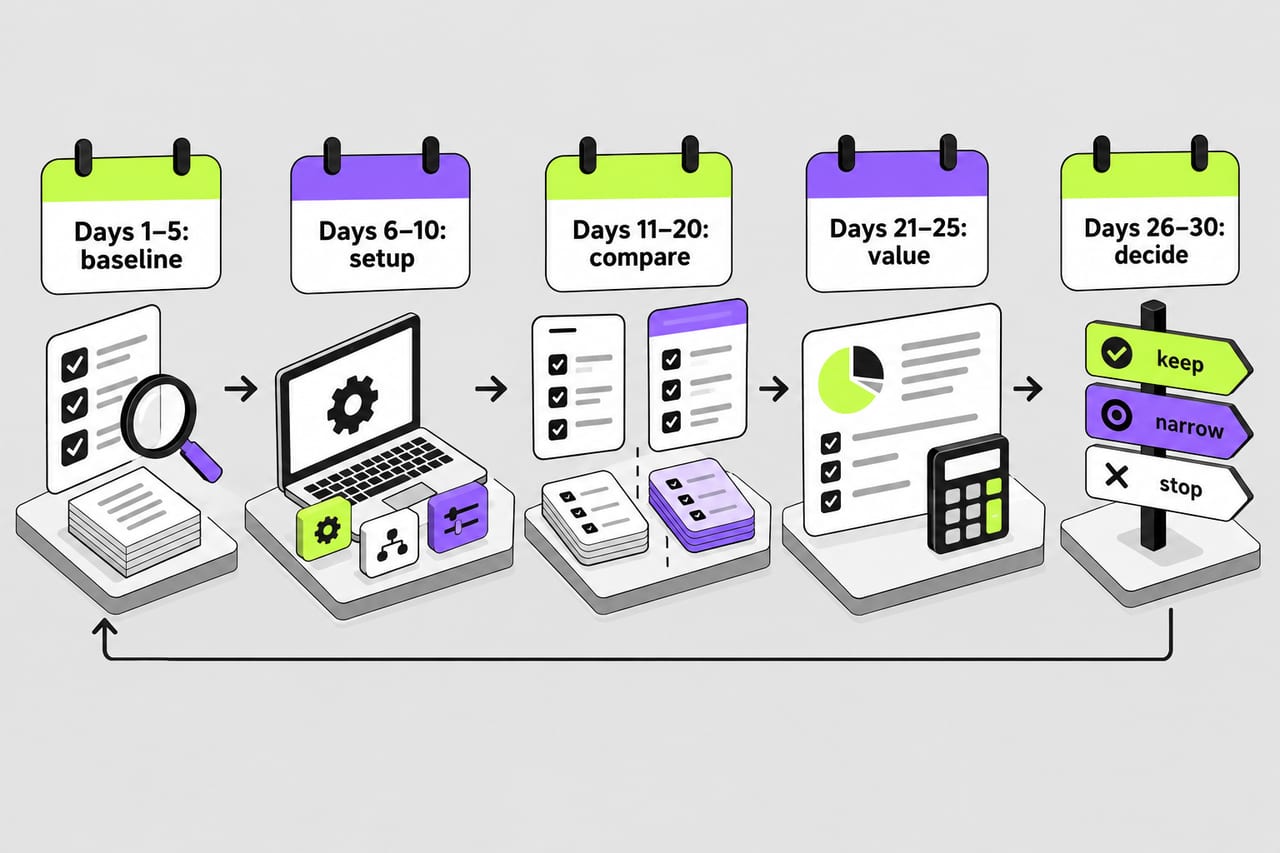
Days 21-25: calculate the value of the saved time
Use a simple estimate: tasks per month multiplied by net minutes saved per task, divided by 60, gives hours of capacity released. Multiply that by your chosen hourly cost, then subtract recurring tool costs. Treat the result as an estimate of time value, not automatically as cash savings.
Here is a fictional example. A business handles 200 routine responses a month. Each takes 12 minutes without AI. With AI, preparing the draft takes five minutes and checking it takes three, for eight minutes in total. The net saving is four minutes per accepted response.
That releases about 13.3 hours a month. At an assumed labor value of €25 an hour, the time is worth about €333. A €60 monthly tool cost leaves roughly €273 of estimated monthly capacity value before setup time, training and additional administration.
Now change one assumption: checking takes seven minutes rather than three. The assisted process also takes 12 minutes, and the apparent time saving disappears. This is why the first draft's speed is a poor substitute for measuring the finished task.
Ask what the released time would be used for. If it lets an employee clear a backlog or handle more inquiries, that can be useful even when the wage bill stays the same. Record that intended use rather than treating every saved minute as additional profit.
Days 26-30: choose keep, narrow or stop
Keep the method when it improves the task consistently at an acceptable total cost. Narrow it when the benefit is limited to a subset of cases, such as routine delivery questions but not complaints requiring judgment. Stop it when correction work erases the benefit or the output cannot meet the existing standard.
Write down the decision, the examples supporting it and any unresolved questions. If you keep the tool, retain the short operating instructions and assign responsibility for occasional checks. Changing the tool or the source material may change the result.
A stopped pilot is still useful if it prevents a larger commitment to a poor fit. The aim of the month is a better decision about one piece of work. Expansion should follow a clear result and another well-defined task.
Common questions
Is 30 days enough to prove a financial return?
It can provide a first operational comparison for frequent tasks. Seasonal work, infrequent errors and long sales cycles may need more observation. Record those limits before treating the result as a long-term forecast.
Should the team count every minute saved as a cost reduction?
No. Time released and expenses reduced are different outcomes. Use the former to plan capacity, and only record the latter when an actual expense changes. The fictional calculation above describes capacity value.
Sources and reporting notes
OECD: Generative AI and the SME Workforce — New Survey Evidence, published November 5, 2025, based on a late-2024 survey. Source checked September 28, 2026. The 30-day plan, business scenario, prices and calculations are original illustrative guidance rather than observed company results.