
How to Build a 13-Week Cash Flow Forecast for a Small Business
Quick answer: A 13-week cash flow forecast estimates the money your business expects to receive and pay out each week. Start with the bank balance you can actually use, add likely collections, subtract dated payments and roll the ending balance into the next week. Update it weekly. The purpose is to see a cash gap early enough to act, not to produce a perfect prediction.
Small businesses can look profitable on paper while running short of cash because invoices arrive late or large bills fall due before customers pay. A short rolling forecast focuses on timing. It is different from a profit-and-loss statement, which records revenue and expenses using accounting rules that may not match when cash moves.
What goes in the forecast?
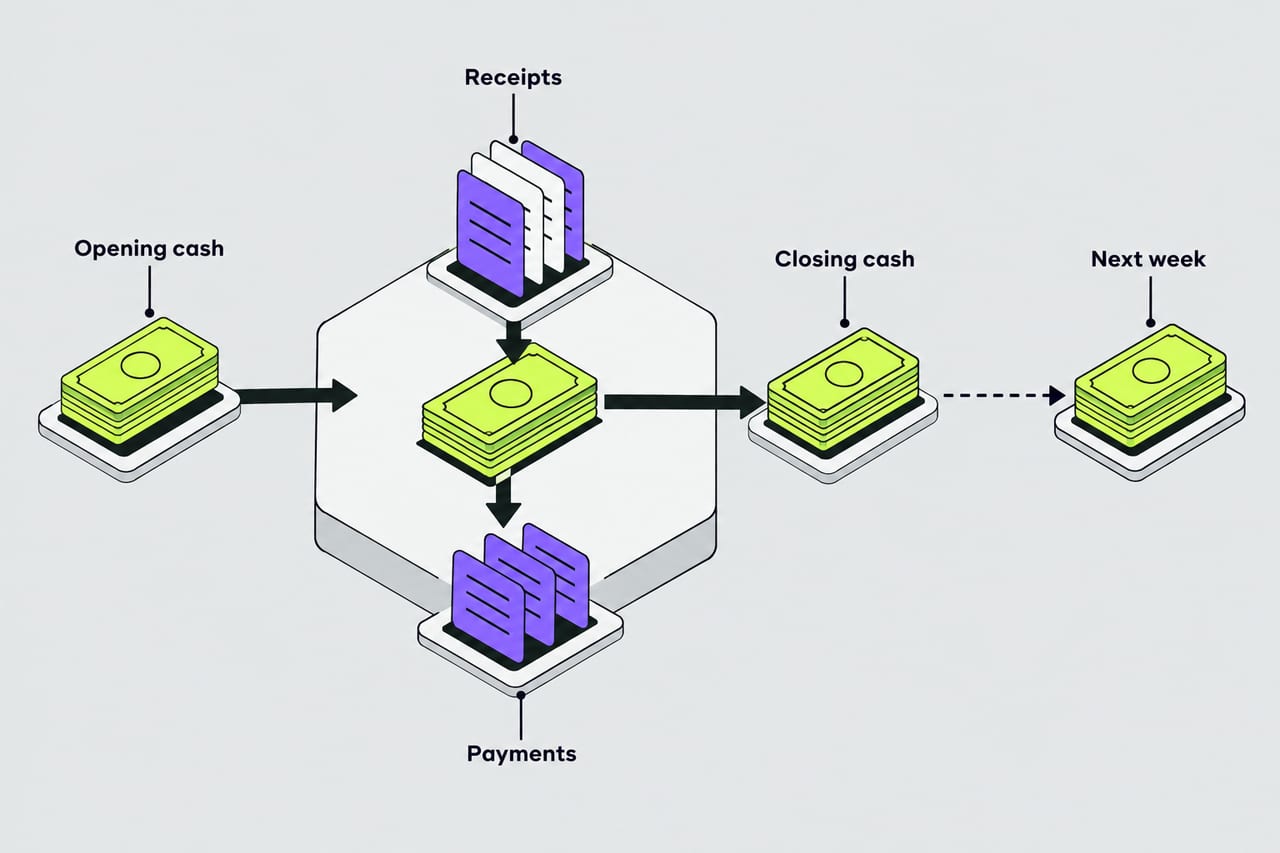
Use one column for each of the next 13 weeks and a few clear rows. Begin with opening cash. Add expected customer payments, other receipts and any already-agreed financing. Subtract payroll, rent, suppliers, taxes, debt payments, owner withdrawals and planned equipment purchases. The formula is simple: opening cash + cash received − cash paid = ending cash. Next week's opening cash equals this week's ending cash.
Use the date you expect money to arrive, not the invoice date. If a customer normally pays two weeks late, reflect that history. Put fixed payments into the week they will clear. Do not count a possible loan or speculative large sale as guaranteed cash. Keep those in a separate upside scenario until the agreement is real.
Build the first version in six steps
- Record usable opening cash. Reconcile the current bank balance and remove funds that are restricted or already committed.
- List money due in. Use open invoices, recurring customer payments and realistic collection dates. Mark uncertain receipts.
- List money due out. Pull the next 13 weeks of bills, wages, loan payments and tax dates from actual records.
- Calculate each ending balance. Carry it forward to the next week; a negative number flags a week to investigate.
- Add a low case. Delay a major customer receipt or reduce new sales, then see how early the balance turns tight.
- Reforecast every week. Replace last week's estimates with actual bank movements, investigate differences and extend the horizon by one new week.
Here is an illustrative two-week example. A shop starts with $12,000. It expects $8,000 in receipts and $15,000 of payments in week one, leaving $5,000. In week two it expects $6,000 in receipts and $9,000 of payments, leaving $2,000. If a $4,000 customer payment in week one slips to week three, week one ends with only $1,000 and week two falls to negative $2,000. The business needs a response before week two, even though the delayed customer may eventually pay in full.
How to respond to a projected cash gap
First check the inputs. Is a payment duplicated? Is a receipt based on a firm promise or a hopeful guess? Then look at actions you can take early: follow up on overdue invoices, request deposits on new work, negotiate payment timing with suppliers or delay a discretionary purchase. If financing is needed, talk to a lender before the balance reaches zero. Some actions have costs or contractual consequences; review those with an accountant or adviser where appropriate.
Keep the forecast honest. Moving a bill into a later column without agreement does not fix the cash problem. Likewise, a one-time sale may solve a week but not an ongoing mismatch between collections and spending. The forecast should lead to an owner decision, not become a spreadsheet that nobody checks.
13 weeks or 12 months?
Use 13 weekly columns for near-term payment timing. Use a monthly model when you need a longer view of seasonality, hiring or investment. SCORE Houston provides a cash flow projection model and links to 12- and 24-month templates that include revenue, costs, compensation, capital spending and cash balances. A business can use both views: the monthly plan sets direction while the weekly forecast catches the next cash squeeze.
Frequently asked questions
Do I need accounting software?
No. A spreadsheet works if it is reconciled to real bank activity and updated consistently. Software can make data collection easier, but it will not correct unrealistic assumptions.
Should I include sales that are only in my pipeline?
Keep uncertain sales in a separate scenario. The base forecast should rely on receipts with a credible amount and expected collection date.
What number should I watch most closely?
Watch the lowest projected weekly ending cash balance and how much it changes when a major receipt is delayed. This reveals the timing and size of a potential gap.
Sources and reporting notes
Checked October 3, 2026: SCORE Houston cash flow projection model and templates. The 13-week format, example figures and weekly review steps are editorial planning guidance; they are not a lender requirement or individualized financial advice.