
How to Verify AI Citations Even When the Links Work
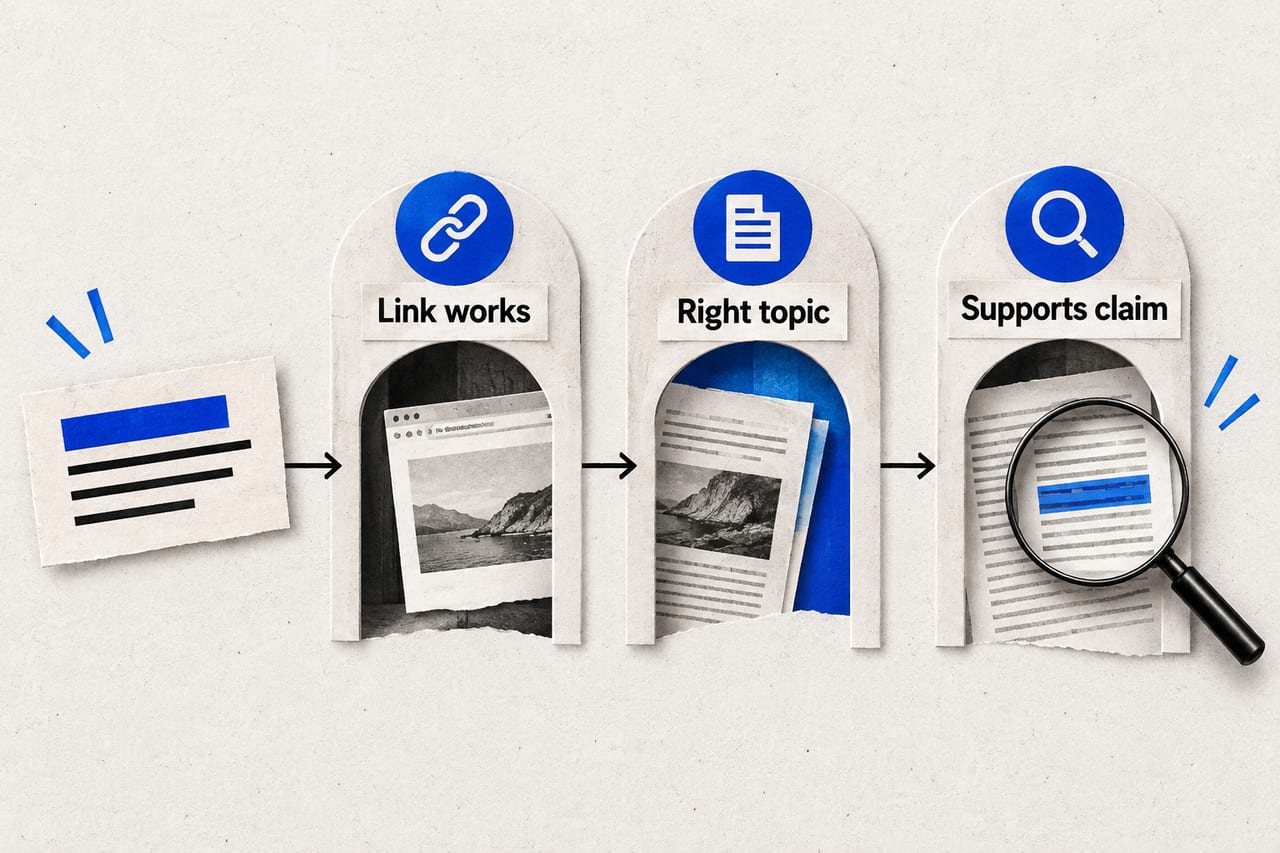
To verify an AI citation, check three things: the source exists, it concerns the right topic, and its actual text supports the exact claim. A working link only passes the first check. A real page can still be cited for a statement it never makes, a price that has changed or a finding that applies to a different group.
This matters when an AI research tool produces a convincing report with a source beside every paragraph. The report can look finished before anyone has checked whether those sources justify the conclusions. You do not need to investigate every sentence equally. Start with the claims that affect your decision, then build a small evidence record you can reuse.
Why a real citation can still be wrong
There are several distinct failure modes. A source can be invented. A real source can discuss a related topic without supporting the statement. Or a source can support part of a sentence while the generated answer adds a stronger conclusion. These problems need different corrections: replacing a missing reference, finding relevant evidence or narrowing the claim.
The NIST Generative AI Profile includes fabricated citations among confabulation risks and recommends reviewing sources and citations during testing and ongoing monitoring. Citation formatting is therefore something to inspect, rather than a signal that the answer has already been verified.
A May 2026 preprint, Cited but Not Verified, evaluates source attribution in deep research agents by separating link accessibility, content relevance and factual support. That separation is useful for readers too. The study concerns the systems and tasks evaluated by its authors; it does not establish an error rate for every AI product or every report.
Step 1: Turn the answer into individual claims
Choose one sentence that matters. Break it up if it contains several assertions. “This service costs $12 per month, includes unlimited exports and works in every country” contains three checks, even if only one source appears at the end.
Copy the wording into a worksheet before editing it. This preserves what you actually checked. Otherwise, a vague memory of the answer can replace the original statement, and you may accidentally verify a weaker claim than the one you intend to publish.
Prioritize prices, eligibility, dates, quantities and causal claims. Descriptive background may need a lighter check. A recommendation that could change a purchase or workflow deserves a direct reading of the relevant evidence.
Step 2: Open the source and identify it
Check the domain, page title, author or organization, publication date and any update date. Confirm that the link leads to the intended document, rather than a homepage, search page or unrelated redirect. For a paper, match the title and authors, not only the subject area.
An inaccessible link is an unresolved citation. It is not automatic proof of fabrication: the page could require a login, have moved or block automated access. Find the publisher's own record if possible. Do not mark it verified based only on a search snippet or the AI's summary of the unavailable page.
Step 3: Find the supporting passage
Search inside the document for the key term, number or phrase. Read the surrounding paragraph, table heading and footnotes. The important qualifier may be one line above the number: a trial period, a sample restriction or a condition that the generated answer omitted.
Use this question: if a reader saw only this source, could they reasonably make the exact claim in my sentence? If the source supports a narrower version, write that narrower version. If you are drawing an inference, explain the inference instead of presenting it as the source's explicit finding.
A worked example: a correct link, an incorrect price
This example is invented for explanation. Imagine an AI answer says, “The plan costs $12 per month throughout the first year.” Its citation opens a genuine pricing page. The page advertises $12 per month for the first three months, followed by $24 per month. The source exists and concerns the right plan, but it does not support the annual-price statement.
| Check | Result | What it means |
|---|---|---|
| Does the page open? | Yes | The link is accessible. |
| Is it about this plan? | Yes | The source is relevant. |
| Does it support $12 for twelve months? | No | The claim must change. |
Under those fictional terms, the first-year subscription total is 3 × $12 + 9 × $24 = $252 before any other charges. The misleading sentence implies $144. The correction requires reading the condition, not generating more links.
Step 4: Check scope, timing and source quality
Match the evidence to the question. A test on one device does not automatically describe every device. A result among existing customers does not necessarily predict results for new visitors. A vendor's demonstration can describe what it demonstrated, without proving that every customer will get the same outcome.
For current product facts, prefer the provider's current documentation. For research findings, read the original study and note whether it is a preprint or peer-reviewed publication. For claims about experiences, distinguish a person's report from a measured pattern. Primary sources can still contain errors; they make the evidence trail easier to inspect.
Step 5: Save a small claim ledger
A useful ledger needs only five fields: the claim, source URL, supporting location, check date and decision. The supporting location could be a section heading, page number or table row. The decision can be supported, partly supported, contradicted or unresolved.
For the fictional pricing example, write “contradicted” beside the original annual-price claim. Add the corrected terms and the calculation in a separate row. Keep the checked wording beside its evidence so a later editor can see why the sentence changed.
This is especially helpful for repeatable work: customer research, article drafts, supplier comparisons and internal briefs. When a source changes, you can update the affected claim instead of rechecking an entire report from memory. To place these checks inside a wider process, use our workflow for getting better AI answers.
Can AI check its own citations?
It can help organize the checks, extract candidate passages and point out mismatched numbers. You still need to inspect the evidence behind claims that matter. A second model can repeat an unsupported statement, especially if you give it the same summary instead of the underlying source.
A useful request is: “For each claim, show the source location, the passage that supports it and any qualification. Mark claims you cannot support.” Treat the resulting worksheet as a review aid. Confirm that the displayed passages are present in the document.
Common questions
Is a citation wrong if it only supports part of a paragraph?
It may support one statement and leave others unresolved. Split the paragraph into claims and attach evidence where it applies. Avoid letting one valid reference appear to justify several unrelated assertions.
Does a newer source always beat an older source?
No. Newness matters for changing facts, such as plans and feature availability. For a stable technical principle, a careful older source may still be appropriate. Match the publication's scope and date to the claim.
How much checking is enough?
Check every decision-driving claim and any statement you cannot responsibly leave uncertain. If evidence remains unavailable or conflicting, say so or remove the claim. A shorter, supported answer is easier to use than a long report whose references have only been opened.