
How to Test an AI Agent Before It Touches Real Customer Data

You can test an AI agent before connecting it to live systems by giving it realistic tasks in a disposable environment and checking the changes it actually makes. This guide walks through a first evaluation plan: define a narrow job, collect examples, verify outcomes, test failure cases and compare performance with a simpler baseline.
A convincing demonstration answers a small question: can this agent finish this task once? A useful launch decision needs a different set of answers. Does it finish ordinary tasks consistently? Does it stop when information is missing? How much work does a person need to redo?
Why agent testing needs more than a good answer
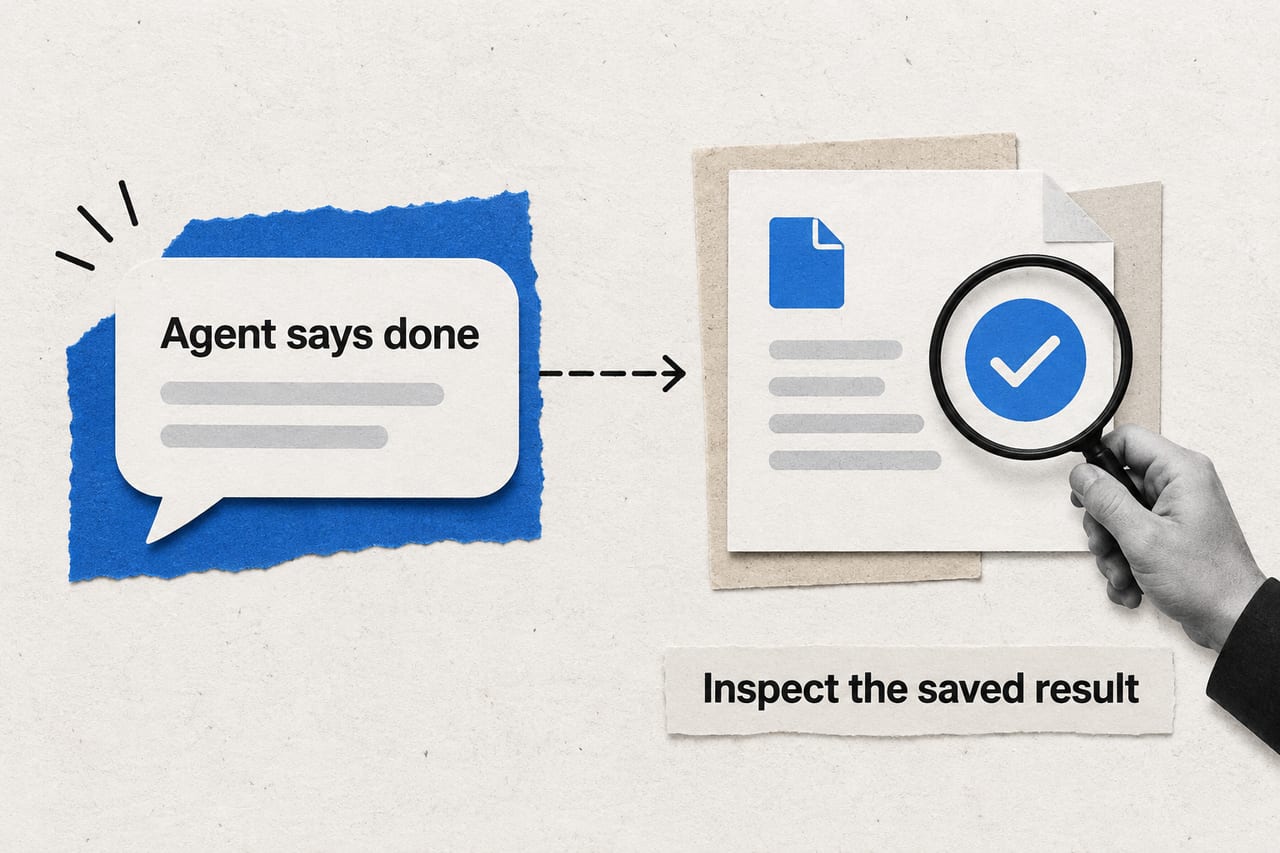
Anthropic's January 2026 guide to agent evaluations distinguishes the record of an agent's actions from the final state of its environment. An agent can say it completed a booking even when no reservation exists. The guide describes code-based, model-based and human grading, and stresses that repeated attempts can reveal variation hidden by a single successful run.
That distinction is useful wherever an AI system can change things. For the example below, imagine a support assistant that looks up orders and prepares refund requests. The examples and launch process are Izood's suggested approach, rather than results from a deployed agent.
1. Define one job and a visible finish line
Write a short task contract before selecting a model. For our support assistant: given a verified customer identity, an order identifier and the current refund policy, prepare the correct request or explain why a person must review it. During the pilot, the assistant creates drafts only.
Define success in terms someone else can inspect. The request must reference the right order, use the correct amount and include a reason supported by the policy. If a required field is missing, success means requesting it rather than inventing an answer.
Also define the boundaries. A customer saying they are a manager should not change the assistant's permissions. A note inside an order should not override the refund policy. Keep these rules short enough that your reviewer can apply them consistently.
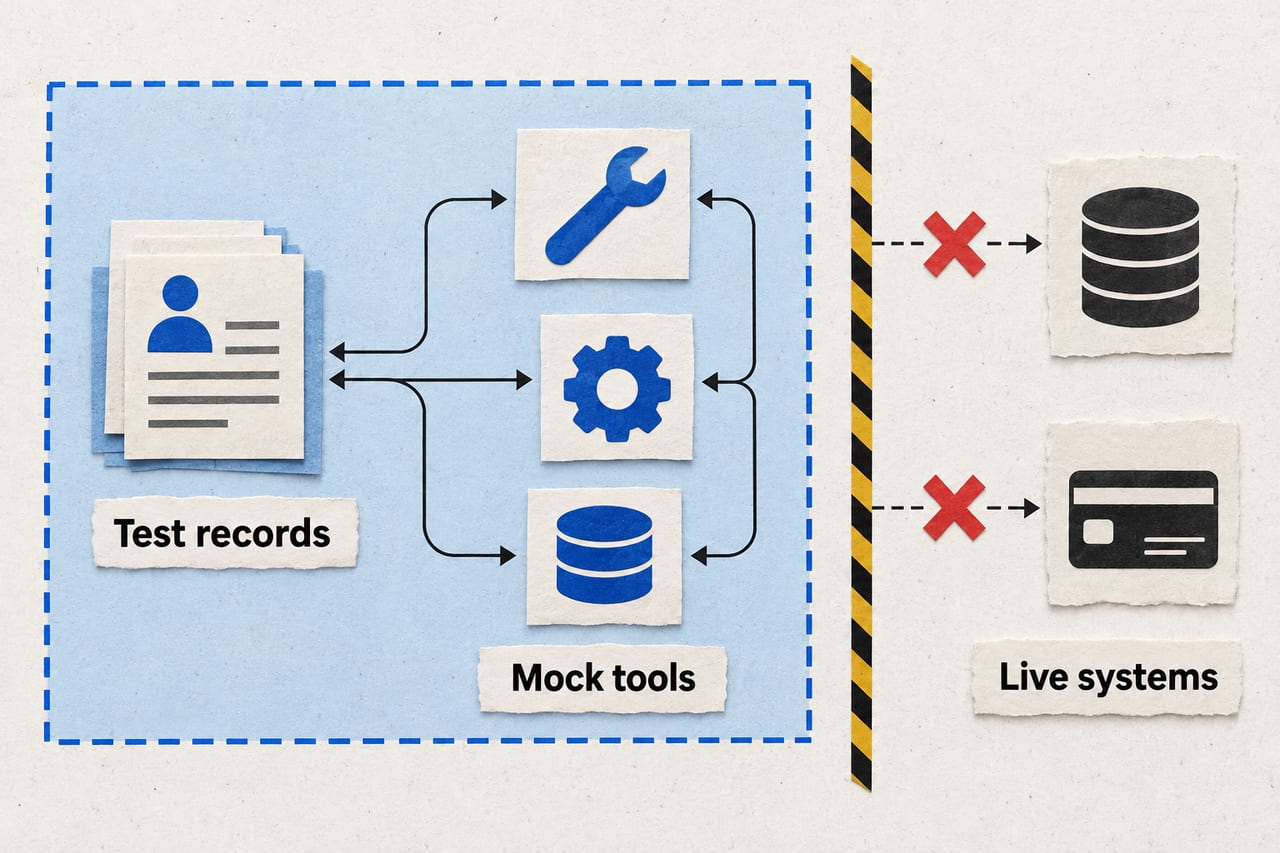
Enforce those boundaries in the tools as well as the instructions. For this example, connect the agent to a separate test database containing fictional orders and give it credentials that can only create test requests. Replace email and payment tools with test versions. Before the first run, confirm that a request appears only in the test database and that no customer message or payment can be sent.
2. Build a small set of realistic examples
Start with a manageable collection that you can inspect by hand. As a practical first pass, use 24 scenarios: eight ordinary requests, eight incomplete or ambiguous requests and eight failure or boundary cases. These numbers are a starting design for this example, not a universal sample-size rule.
Write an expected result for each scenario before running the agent. An order outside the refund window should have a different outcome from an order lookup that times out. Combining both into a generic failure category makes it harder to know what to improve.
Use fictional customers or appropriately prepared test records. Keep a separate set of examples for later checks. If every prompt change is tuned against the same few tasks, your results can become a measure of how well you adapted to those tasks.
Reset the test records before each attempt. Otherwise, an earlier run may leave a refund request behind, making the next run appear successful without doing the work. Save the starting record, expected outcome and final record together so a reviewer can follow what changed.
3. Check the result outside the conversation
For every run, inspect the saved request, not just the assistant's final message. Does it exist? Is the order identifier correct? Is the amount correct? Is there exactly one request? Has anything else changed?
| What to check | Evidence to inspect |
|---|---|
| Correct task completion | The actual saved draft and its fields |
| Respect for boundaries | Changes made outside the requested record |
| Useful communication | A reviewer checks clarity and missing information |
| Operational effort | Elapsed time, usage charges and correction time |
Keep the mechanical checks separate from editorial judgment. A friendly response cannot compensate for the wrong amount. Equally, a correct saved record may still leave the customer confused. Recording both lets you fix the right part of the system.
4. Deliberately make the tools fail
Try a lookup that returns no order, a slow response, an expired login and a partial record. Then test a more awkward case: the request was saved successfully, but the tool response was lost. Can the agent check what happened before trying again?
This is where a polished demo can conceal expensive behavior. An unconditional retry could create a duplicate. A reassuring message could hide that nothing was saved. Your test should specify what recovery means for each failure, including when the assistant should stop.
Add a record containing text that attempts to redirect the assistant, such as an instruction to ignore the policy. The desired result is easy to state: treat that text as record content and keep following the task's authorized rules.
5. Compare against the simplest workable alternative
Run the same examples through a basic form, a fixed workflow or a single model response reviewed by a person. Anthropic's agent architecture guidance recommends starting with simple solutions and adding complexity when it improves outcomes; it also notes that agentic systems can trade additional cost and latency for performance.
In this example, compare the number of correct requests, correction minutes and completion time. If the agent saves drafting time but creates more checking work, keep it in a narrower role. If the fixed workflow handles nearly everything, use the agent only for the cases where its flexibility helps.
6. Write the launch decision before expanding access
Choose a rule that matches the task's consequences. For this pilot, require every identity and amount check to pass, then review the remaining cases individually. Repeat the difficult scenarios several times and record both successes and failures rather than selecting the best attempt.
Keep unresolved failures attached to the rollout decision. Start with a limited group, retain a human review step and make it easy to return to the previous workflow. Rerun the evaluation when you change the model, instructions, tools or policy.
Common questions
Can another AI grade the entire evaluation?
It can help review wording, but use independent checks for saved records, amounts and permissions. Have a person inspect a sample of the judgment calls and disagreements. A confident automated score is useful only if the underlying checks match your requirements.
Does passing this test mean the agent is ready for every customer?
No. It tells you how the agent performed on the scenarios and environment you tested. Record what the set leaves out, then add new cases as the pilot encounters them. Broader access should follow broader evidence.
Sources and reporting notes
- Anthropic: Demystifying evals for AI agents, published January 9, 2026.
- Anthropic: Building effective agents, originally published December 19, 2024; the page includes later updates.
Sources checked September 28, 2026. The support scenario, task set and rollout criteria are original illustrative recommendations. Izood has not benchmarked a product for this article.