
How to Price an AI Product: Tokens, Credits, Subscriptions or Outputs?

The best AI product price is usually based on a unit a customer understands and you can measure reliably. Charging directly for model tokens may protect a young product's margins, but it can leave buyers paying for the complexity of your infrastructure. A task, document, image or resolved support request is easier to connect to delivered work. The right model depends on who buys the product, how variable its costs are, and whether the billed unit can be audited.
Stripe published a fresh argument for this distinction on October 1, 2026: token metering is useful behind the scenes, while customer-facing pricing should reflect value. That is a viewpoint from Metronome's founder, published by Stripe—not a universal rule. Here is a practical framework for founders comparing subscriptions, tokens, credits and output-based pricing.
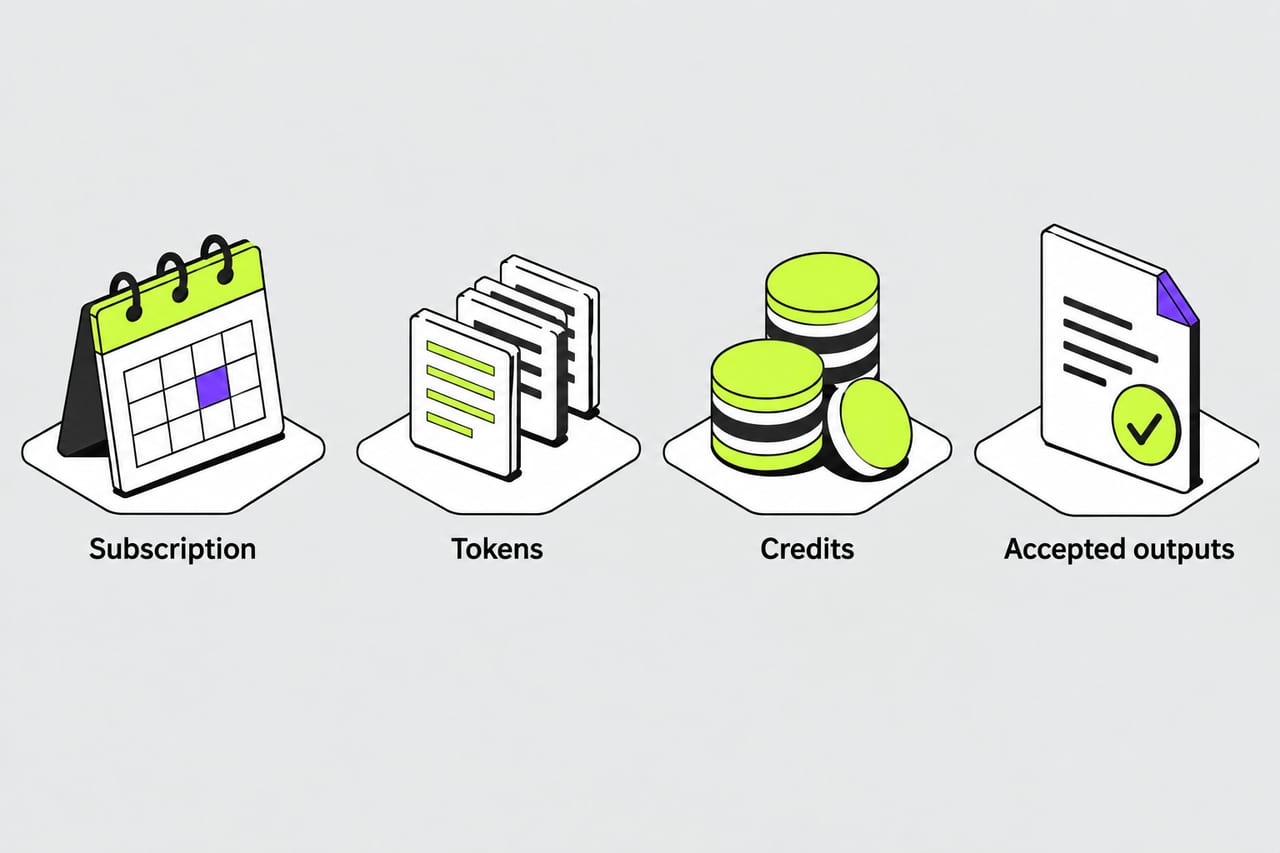
Four common AI pricing models
| Model | Customer sees | Main strength | Main risk |
|---|---|---|---|
| Subscription or seat | A fixed monthly amount per plan or user | Predictable buying decision | Heavy users can exceed the economics built into the plan |
| Token usage | Input and output tokens, often with a markup | Close link to underlying model cost | Hard for nontechnical buyers to forecast or relate to value |
| Unified credits | A balance consumed by different actions | One purchasing unit for varied workloads | Unclear exchange rates can make the bill opaque |
| Outputs or tasks | Images, enriched records, completed actions or resolutions | Easy to understand the delivered unit | Cost per output can vary and quality needs a definition |
A hybrid combines a base subscription with usage or overages. Stripe's AI pricing guide describes this as one way to offer predictable access while accounting for variable compute costs. The table is a decision aid, not a claim that one structure wins every market.
Why token billing can be the wrong customer invoice
A token is a measurable unit of model input or output. For an API sold to developers, tokens can be a natural charge metric: the buyer understands the model they chose and can meter usage. For a product that promises a finished sales brief or a processed invoice, tokens are internal plumbing. A customer who asks for the same result twice may receive a different token bill because the model routed differently or an agent needed extra steps.
In “Why I tried to kill token billing”, Metronome founder Scott Woody argues that the customer invoice should describe the work the product performs, not expose model counts and markups. His point is also a warning about positioning: if buyers see only a surcharge on somebody else's model, they may question what the product adds. That is his analysis; the correct metric still needs customer interviews and margin testing.
When credits make sense
Credits can bridge the gap between unstable compute costs and a buyer-friendly package. A customer buys one balance, while different tasks draw it down at different published rates. An image generation might cost more credits than a short classification. The product can still track token costs internally and change which model does the work without making every invoice a model-cost ledger.
The catch is transparency. “100 credits” means little until a buyer can estimate how many useful tasks that buys. Publish examples for ordinary workloads, show the remaining balance in the product, and state what happens when a task fails or is retried. Treat a credit schedule as a promise about billable work, not as an invitation to hide volatile exchange rates.
Outputs versus outcomes
An output is something the product can count and verify: a generated image, an enriched record, or a support conversation meeting a defined resolution rule. A business outcome is the customer's larger result, such as more revenue or lower churn. The two are not identical. A sales email sent is measurable; a sale caused by that email may involve a salesperson, advertising and the customer's pre-existing intent.
That attribution gap is why many apparently outcome-priced AI products actually bill for a well-defined output. Stripe's Intercom case study describes Fin's charge per resolved support conversation and the need to define what counts. Woody's October essay calls such resolutions outputs rather than ultimate business outcomes. You can disagree on the label while still learning the operational lesson: document the countable event, quality threshold, exclusions and dispute process.
How to choose a charge metric
- Interview buyers. Ask what job they pay you to complete and what they currently use as evidence of success.
- Measure variable cost. Track model, tools and retries per task; compute the full cost distribution, including unusually expensive runs.
- Pick a unit that is auditable. Define when a task begins, succeeds, fails and becomes billable.
- Test the invoice. Show a sample month to a buyer. If the units need a paragraph of explanation, simplify the presentation.
- Add controls. Give customers spending limits, usage visibility and alerts; put operational limits on runaway agent loops.
- Review margins and retention. Compare what heavy and light users cost with what they pay, then adjust carefully.
These steps align with Stripe's broader framework: define customer value, choose a charge metric, choose the package, add guardrails and iterate. For engineering teams, Stripe's usage-billing guide adds another practical point: reliable event attribution, deduplication and correction policies are necessary before a metered invoice can be trusted.
A small example
Imagine a research assistant that produces an accepted competitor brief. Ten briefs each month might cost the vendor very different amounts in model usage because some sources are harder to parse. A $99 flat plan is easy to buy but can underprice heavy research. Raw token pass-through protects cost recovery but makes the brief's price unpredictable. A base plan with a defined number of accepted briefs and a clear per-brief overage could give the buyer predictability while allowing the vendor to monitor compute cost internally. The dollar figure is illustrative, not a recommended price.
The key is the word accepted. Define whether a brief rejected for missing citations consumes an allowance, whether revisions are included, and how long a buyer has to flag an error. A polished pricing page cannot compensate for an undefined billing event.
Frequently asked questions
Is per-token pricing always bad?
No. It can fit a developer API where model usage is the service being purchased. It is often less intuitive when an application sells a finished business task.
Are credits better than usage pricing?
Credits are one way to package usage. They help only if customers can see a clear conversion from credits to work and understand limits, refunds and expiration.
What is hybrid AI pricing?
A base subscription paired with a metered component such as tasks, credits or usage beyond an included allowance.
Should an agent charge for outcomes?
Only if the result can be attributed and verified clearly enough that both parties agree on the bill. A countable output is often simpler.
Sources and reporting notes
Checked October 3, 2026 against Scott Woody's October 1 essay on Stripe, Stripe's AI product pricing guide, its AI usage-billing guide and Intercom pricing case study. The four-model table, checklist and example are our synthesis, not Stripe product claims.